


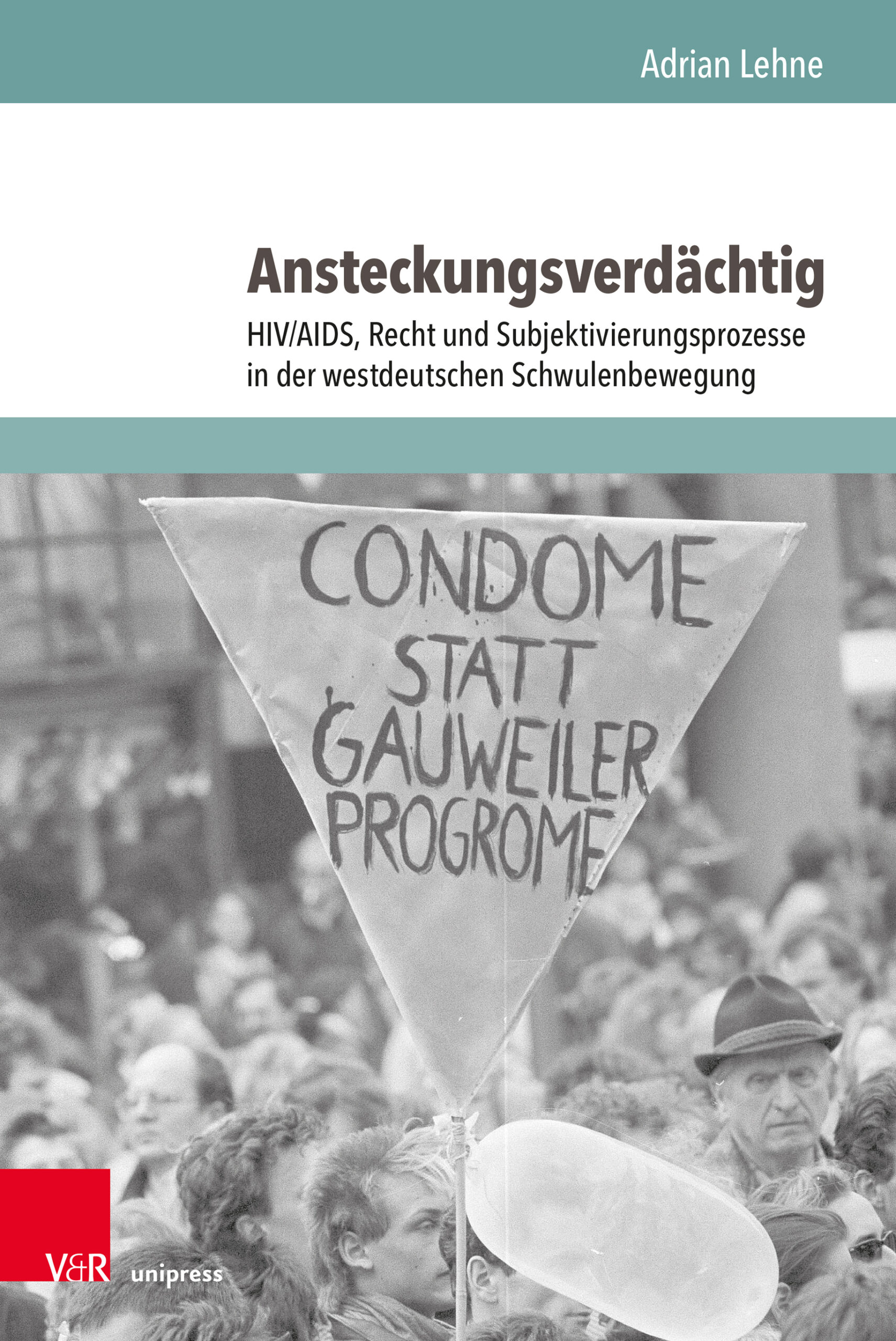
Adrian Lehne: Ansteckungsverdächtig. HIV/AIDS, Recht und Subjektivierungsprozesse in der westdeutschen Schwulenbewegung. In: Sebastian Bischoff, Julia König & Dagmar Lieske (eds.): Sexualities in History – Sexualitäten in der Geschichte, vol. 2, V&R unipress: Göttingen 2025. Open Access
A Contagious History
Adrian Lehne’s Ansteckungsverdächtig joins a small but memorable body of German-language work on the history of HIV and AIDS. A comparable study for Austria is still missing.
A review by Max Sohm
With Ansteckungsverdächtig, Adrian Lehne presents the revised version of his dissertation, accepted at the Freie Universität Berlin in 2022. The book appears as the second volume in the series Sexualities in History and emerged from the DFG research group »Recht Geschlecht Kollektivität«. It examines the gay movement in the old Federal Republic and in reunified Germany between the first description of AIDS in 1981 and the presentation of combination therapies in Vancouver in 1996. The study thus takes its place in a research landscape running from Henning Tümmers’ Aids. Autopsie einer Bedrohung im geteilten Deutschland (2017) through Martin Reichert’s Die Kapsel (2018) to Sebastian Haus-Rybicki’s Eine Seuche regieren (2021). For Austria, no such work exists.
Law as an arena
At the centre stands the question of how the engagement with law in the context of HIV/AIDS leads to legal-political mobilisation and to processes of collectivisation. Law appears here as a subjectivating authority and as an arena of confrontation with the state. Lehne combines historical discourse analysis with praxeological approaches. The basis is a corpus of 1,904 articles from eight movement and community magazines, among them Siegessäule, Du&Ich, Magnus and Rosa Flieder. Their distribution shows a marked discursive intensification in the years 1987 and 1988. Added to this are holdings from the Schwules Museum, the Forum Queeres Archiv München, the Stadtarchiv Hildesheim and the Archiv Grünes Gedächtnis, as well as four narrative interviews with activists of the movement. Lehne states openly that only two of them fed directly into the account.
Six findings
The concluding chapter draws together six central findings. Central is the role of knowledge in the juridical field. Non-legal knowledge enters the law above all through academically published knowledge, which is why activists acquire and circulate social-science expertise. Building on this, Lehne shows how the movement opens up new legal practices for itself. Legal knowledge circulates within the community, legal guides are produced, and proceedings are conducted strategically. The Bavarian trial of Linwood B. serves as a case study. Through the law, gay subjectivities are reformatted. Discrimination related to HIV and AIDS pushes the significance of Section 175 of the German Criminal Code into the background, which was repealed in 1994, with HIV/AIDS among the reasons cited. At the same time, the funds raised in the course of the AIDS crisis expand the spaces of gay community building, for instance with the founding of Berlin’s Mann-O-Meter and the support for the Waldschlösschen conference centre near Göttingen. It also becomes visible how closely the liberal AIDS policy of the Federal Republic remains tied to the concept of self-help, and how tendencies of neoliberalisation and left-wing social struggles interlock in the process. The sixth point concerns transnational references. Safer sex is imported from the USA, and the founding of the Deutsche Aids-Hilfe and later of ACT UP receive decisive impulses from there.
A Viennese gap
For a Viennese readership, the book is of interest in two respects. It provides the model for a study that is still outstanding for Austria. And it contains incidental traces of exchange across the border. In a footnote, Lehne records that a meeting of Berlin gay groups in April 1983 considered adopting the information brochure of HOSI Wien, referred to there as a leaflet (p. 98, n. 363). Such references remain marginal notes, but they make visible how readily the German-speaking movement drew on one another’s material. Lehne draws the limits of the work himself. The GDR remains outside the scope for the period before 1990, after the Wende East Germany comes back into view. The corpus rests on printed magazines and thus depicts above all the organised and writing part of the movement. What distinguishes Ansteckungsverdächtig is the precision with which Lehne describes the law as both a tool and an imposition. The book is freely accessible and therefore also immediately available for work on an Austrian history of AIDS.