


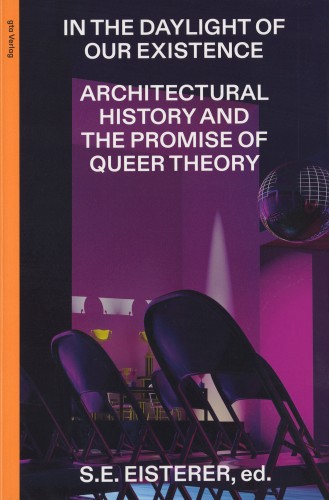
S.E. Eisterer (Ed.): In the Daylight of Our Existence. Architectural History and the Promise of Queer Theory, Zurich: gta Verlag, 2025. Open Access
A Room of One’s Own
The essay collection “In the Daylight of Our Existence. Architectural History and the Promise of Queer Theory,” edited by S.E. Eisterer, sheds light on queer space-making practices, from an intersectional perspective.
A review by Felix Vofrei
“In the Daylight of Our Existence” is a quotation from the Black poet and writer June Jordan and at the same time the starting point of the essay collection published in 2025 by S.E. Eisterer, Assistant Professor of Architectural History and Theory at Princeton University and co-founder of the Queer Space Working Group.
Architecture is political
As the preface to the 288-page book makes clear, Eisterer understands architecture not as neutral but as always embedded in gendered, racialised and colonial processes of power, which, she argues, (queer) architectural history has so far failed to address adequately. In contrast to previous research on queer architecture, which has dealt above all with nightlife and cruising sites of predominantly gay white cis male middle-class subjects, most notably Aaron Betsky’s “Queer Space. Architecture and Same-Sex Desire” published in 1997, Eisterer includes space-claiming practices of multiply marginalised groups that do not necessarily find expression in permanent physical structures. The editor is concerned here with designing alternative futures: “Confronting these histories is also necessary to strategically and creatively envision what could lie beyond. Which imaginations of the environment would become possible if we not only acknowledged but actively thought with nonstatic ways of being in design? […] This book does not provide definitive answers to these questions, but it offers histories and theories of their possibilities.” (p. 8)
Space as a site of collective negotiation
In “Introduction: In the Daylight of Our Existence,” Eisterer argues for a Black feminist architectural theory in Jordan’s writings and follows her in holding that space forms the basic precondition for emancipation: “This book builds on Jordan’s and Cohen’s premises, both on their intersectional and coalitional framework and their advocacy for space and the environment as fundamental arenas where ‘queer’ politics and theory can be radically imagined.” (p. 14) Eisterer’s introduction is informed by the writings of Black feminists and by postmodern theory, which foreground care and more-than-human relations in times of ecological collapse.
Queerness is conceived by the author not as a rigid identity category but as a political practice that takes on those in power and finds expression in ever new architectural configurations: “Drawing on major insights from contemporary trans and queer theory, the book moves away from a facile notion of shared histories of stable identity categories. Rather, authors gathered in this volume are interested in nuancing how these histories and contingencies shaped differing relationships to dominant forms of power and how they enabled alterations, repair, and re-envisioning of the built environment.” (p. 15)
Queering the archive
Together with Ladi’Sasha Jones, a designer and curator from Harlem, Molly M. Brandt, a doctoral candidate in architectural history and theory at Princeton University, and Catherine George Weilein, a researcher and writer working on architecture as a social site, Eisterer sets out the programme of the book in “Archives, Intertexts, and Friendship: Notes on the Essays in this Book.” The volume presents itself less as architectural history or theory than as a work operating with concepts from critical urban studies that foreground the relationships between inhabitants.
The contributions draw on a wide range of source material such as poems, texts, photography, film or interviews with contemporary witnesses, material that has so far had no place in classical architectural historiography: “These texts also mark a different type of writing theory. As the introduction contends, theory—feminist and queer theory in particular—might be found in unlikely places: novels, free writes, poetry, and in practice—that is, in the everyday ways people make themselves at home in cities.” (p. 40)
The book is then divided into three parts, “Cooperative Infrastructures Against the State,” “Public Domesticies, Domestic Publics” and “Ecologies of Friendship,” each containing two essays.
Alternative spaces
The first part deals with alternative spaces that women and queers (of colour) created for themselves outside mainstream society.
Marco Rio’s “Architecture Is Burning: An Urbanism of Queer Kinship in New York Ballroom Culture” examines the practices of queer and trans people of colour who created collective spaces in 1970s and 1980s New York, spaces that have not necessarily survived in fixed built structures. Rio, who researches architecture in countercultures, nightlife and popular culture and co-founded the Queer Educators in Architecture Network (quean), at the same time uncovers lines of tradition within the Black working class by tracing the history of the Imperial Elks Lodge, which served in the 1920s as the seat of the very first African American trade union and, decades later, as a venue for balls.
“Self Help as Spatial Practice: California’s Feminist Women’s Health Centers” comes from the pen of M.C. Overholt, whose dissertation currently investigates the connections between architecture and sexology in twentieth-century America. In this contribution, Overholt examines the spaces of the Federation of Feminist Women’s Health Centers (FFWHC), which ran feminist self-help clinics from the 1970s to the 1990s, as a testing ground for practices of collective living and working. She reads the improvised and flexible character of the facilities, with their carpets and sofas, as a counterpoint to the architectural austerity of the medical sphere. Beyond that, she interprets the reinforced façades and screening as a response to increasing violence from anti-abortion activists and at the same time as a barrier against potential (Black or queer) allies.
Practices of resistance
The second part of the book, “Public Domesticies, Domestic Publics,” focuses on the state not as benefactor but as monitor, one that spatially separates and controls marginalised subjects and ultimately displaces them.
Candace Borders is a postdoctoral fellow at the Center for the Humanities at Washington University and completed her PhD in American Studies and African American Studies at Yale University. Her work is concerned with how African American women shape the urban landscape. Her essay “Toward a Method of Black Feminist Refusal in the St. Louis Rent Strike of 1969” deals with Black feminist resistance to ghettoisation and poor living conditions, as well as with the imagination of a Black liberation based on collectivity and without private property. The 1969 rent strike lasted a total of nine months and involved more than 2,400 participants. The author shows how the women refused the racist ascriptions that used Blackness as a justification for their poor living conditions, revealing public space instead as inherently gendered and racialised.
The second section closes with Germán Pallares-Avitia, a Mexican architect and researcher who teaches as an Associate Professor at the Rhode Island School of Design. He addresses the demolition of the red-light district Calle Mariscal in Ciudad Juárez on the US border by the Mexican authorities in 2010 and situates it within a longer history of the settler-colonial project. He traces how, in the course of the temperance movement in the United States, brothels and nightlife shifted to the Mexican border towns, which continued to be diligently frequented by US Americans. He assesses the Programa Nacional Fronterizo (National Border Program, PRONAF), through which segregated bars and brothels emerged in the so-called Boy’s Towns in the 1960s, as well as the demolition of Calle Mariscal in 2010, as a continuation of settler sexuality, which privileges the white heterosexual nuclear family and disadvantages other sexualities and ways of life.
Expanding the canon
The final part questions the dominant canon of architectural history and considers canonised positions from the perspective of friendship and care.
Torsten Lange, Professor of Cultural History of the Built Environment at the Lucerne University of Applied Sciences and Arts, addresses in his essay “Infrastructures of Friendships: Amerigo Marras and the Art & Communication Group in Toronto” how the activities of the Art & Communication Group, co-founded by Amerigo Marras, in the 1970s are to be seen as an expression not of the heterosexual nuclear family but of interpersonal relations among friends. While the group initially inhabited a Victorian-style house that, Lange argues, became penetrable or inhabitable much like the bodies of those involved in relationships that were not only platonic, later designs moved away from actual physical architectures towards an “unarchitecture” (p. 227). For further reading, see Jack Halberstam’s recent book “Anarchitecture After Everything. A Trans Manifesto” (2026).
The contribution “Planning as Resistance in June Jordan’s New York” by Davy Knittle concludes the book and, through its engagement with Jordan, closes the thematic arc back to the beginning. Davy Knittle is Assistant Professor of English at the University of Delaware and works on how race, sexuality and gender informed the reshaping of the built environment in the United States from the 1950s onwards. Drawing on Jordan’s project “Skyrise for Harlem” as well as on poems and a novel, he shows how she asserted herself against the racist stereotyping of Black women in the Moynihan Report and criticised the urban planning of the 1950s and 1960s as structurally racist. Jordan’s democratic visions centre Black perspectives and emphasise the need for a vocabulary for the needs of inhabitants as well as the connection between humans and nature.
Room to grow
Overall, as already noted, the collection is less concerned with static architecture in the classical sense than with writing a social and cultural history of queer space-making practices. With its intersectional approach, it represents a genuine enrichment of the research field of queer architecture and urban planning. Written from an interdisciplinary perspective, the contributions engage with the sparsely documented histories of women and queers, in some cases multiply marginalised, who anticipated collective practices of living together. It is only consistent, then, that the book is freely available to all in open access.